Oct 24, 2026Wholesale Buying Guide
How to Calculate Landed Cost When Buying Wholesale from China: A Practical Guide for Importers
Learn how to calculate landed cost when buying wholesale from China, including product cost, freight, duties, inspection, customs, and delivery expenses.
Author: Connor Ma, Founder of SML Supply
Published by: SML Supply
The price quoted by a Chinese supplier is not necessarily the real cost of the product.
A product may leave the factory at $3.00 per unit, but by the time it reaches your warehouse, additional expenses may include packaging, inspection, domestic transportation, international freight, customs clearance, import duties, taxes, and final delivery.
The total amount required to bring the goods to their final destination is generally referred to as the landed cost.
Understanding landed cost is essential for importers, wholesalers, distributors, retailers, and private-label buyers because purchasing decisions based only on factory price can be misleading.
A supplier offering the lowest unit price does not always produce the lowest final cost.
This guide explains how to calculate landed cost when buying wholesale from China, which expenses should be included, and how buyers can compare different sourcing and shipping options more accurately.
What Is Landed Cost?
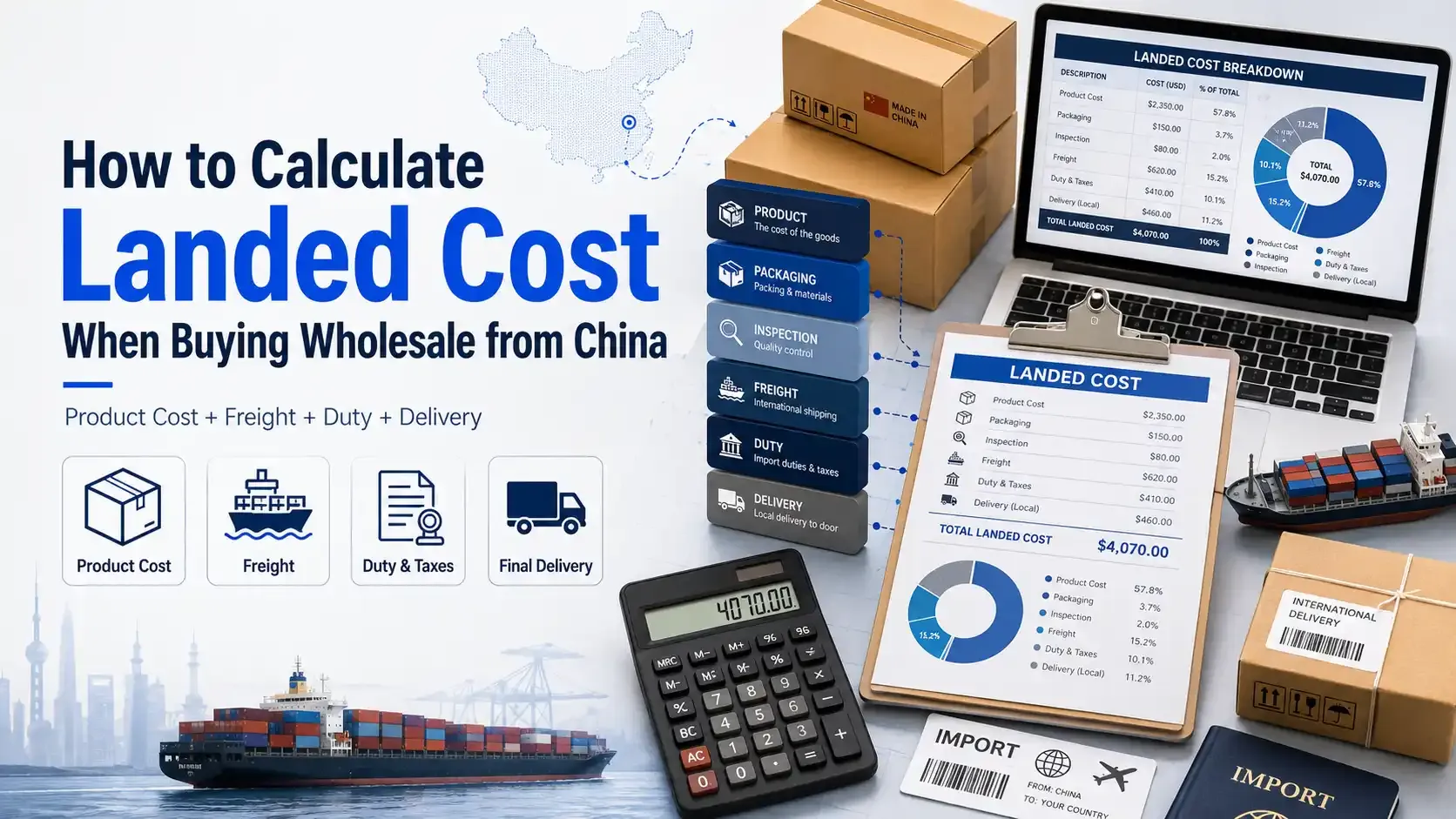
Landed cost is the total cost of purchasing a product and getting it to the point where it is ready to be sold, distributed, or stored in the destination market.
A simplified landed cost formula is:
Product Cost + Origin Costs + Inspection + Freight + Insurance + Duties and Taxes + Customs Charges + Final Delivery = Total Landed Cost
The exact calculation varies depending on:
- product category
- supplier location
- Incoterm
- shipment size
- shipping method
- destination country
- tariff classification
- packaging
- customs procedures
- local delivery requirements
For this reason, landed cost should be calculated on an order-by-order basis.
Why Landed Cost Matters
Many buyers compare suppliers using only unit price.
For example:
Supplier A: $4.20 per unit
Supplier B: $4.00 per unit
Supplier C: $3.85 per unit
Supplier C appears cheapest.
But suppose Supplier C is located farther from the export port, uses larger cartons, requires additional export handling, and produces heavier packaging.
The final transportation cost may be higher.
Supplier A could eventually have the lower landed cost even though the initial product price is higher.
This is why wholesale buyers should compare total purchasing cost, not just factory quotation.
If you are still comparing supplier quotations, see our guide on how to negotiate wholesale prices with Chinese suppliers.
The Main Components of Landed Cost
A complete landed cost calculation usually includes several cost categories.
Not every shipment will contain every expense, but buyers should review each one.
1. Product Cost
The first component is the value of the goods.
For example:
2,000 units × $4.00 = $8,000
However, make sure you understand exactly what the supplier's unit price includes.
The quotation may or may not include:
- logo printing
- custom labels
- individual packaging
- retail boxes
- cartons
- inserts
- barcodes
- assembly
- accessories
- tooling fees
Before calculating landed cost, the product specification and quotation should already be clear.
2. Customization Costs
Customization may be included in the unit price or quoted separately.
Common additional costs include:
- logo printing
- embroidery
- engraving
- private labels
- hangtags
- custom colors
- custom packaging
- stickers
- printed inserts
- molds
- tooling
- artwork setup
For example:
Product cost: $8,000
Logo printing: $300
Custom packaging: $500
Total product-related cost:
$8,800
One-time tooling costs should usually be recorded separately from recurring unit costs because they may not apply to future orders.
3. Sample and Product Development Costs
For new products, the sourcing process may include sample and development expenses.
These can include:
- sample charges
- courier costs
- mold development
- prototype development
- color matching
- packaging samples
- printing setup
- testing samples
Whether these costs should be included in the landed cost of the first shipment depends on how you manage internal accounting.
For purchasing analysis, however, buyers should at least record them so the true cost of launching the product is understood.
SML Supply's Product Development process can support buyers who require product customization before mass production.
4. Packaging Costs
Packaging has a direct effect on both product cost and freight cost.
This includes:
- individual packaging
- retail packaging
- master cartons
- protective materials
- pallets
- wooden cases
- labels
- barcodes
- inserts
A custom box may add only $0.30 per unit, but it can also increase the volume of every carton.
That means packaging can increase cost twice:
First: higher packaging cost.
Second: higher international freight cost.
When comparing packaging options, buyers should therefore consider both price and shipping volume.
5. Quality Inspection Costs
Pre-shipment inspection is another cost that should be considered.
Inspection expenses may include:
- inspection service
- inspector transportation
- laboratory testing
- product testing
- reinspection
- sample verification
Skipping inspection may reduce the apparent purchasing cost, but defective goods can create much larger losses after import.
Typical risks include:
- incorrect specifications
- damaged packaging
- wrong colors
- missing accessories
- poor workmanship
- incorrect quantities
- labeling problems
A proper cost calculation should therefore consider quality control as part of purchasing risk management rather than treating it as an unnecessary expense.
6. Domestic Transportation in China
Goods usually need to move from the supplier's factory or warehouse to:
- an export warehouse
- consolidation warehouse
- freight forwarder
- airport
- railway terminal
- seaport
These domestic transportation costs may or may not be included in the supplier's quotation.
The answer often depends on the Incoterm.
For example, an EXW quotation typically transfers more transportation responsibility to the buyer than an FOB quotation.
Always confirm the exact pickup and delivery point.
7. Export Handling Costs
Depending on the shipping arrangement, origin-side charges may include:
- warehouse handling
- export documentation
- customs declaration
- terminal handling
- container loading
- consolidation
- port charges
- documentation fees
These costs vary according to shipment type and Incoterm.
Buyers should ask the freight forwarder for a clear breakdown instead of focusing only on the quoted ocean or air freight rate.
8. International Freight
International freight can represent a significant portion of landed cost, especially for low-value or bulky goods.
Common shipping methods include:
- sea freight
- air freight
- rail freight
- courier
- truck transport for certain routes
The best option depends on factors such as:
- shipment weight
- shipment volume
- product value
- urgency
- destination
- order quantity
Heavy or bulky products usually make freight efficiency especially important.
A low-cost product can become commercially unattractive if international transportation accounts for a large percentage of the final landed value.
9. Freight Insurance
Cargo insurance may be relatively small compared with the total order value, but it should still be considered.
Insurance can help protect against certain risks during transportation.
The appropriate coverage depends on:
- product value
- shipping method
- route
- Incoterm
- commercial agreement
Buyers should confirm what insurance is included, if any, rather than assuming all freight quotations provide the same protection.
10. Import Duties
Import duty depends on the product classification and destination country.
Different products may have different tariff rates.
For example, textiles, electronics, plastic products, stainless steel goods, toys, and household items may all be classified differently.
The applicable duty may depend on:
- HS code
- product description
- material
- country of origin
- destination country
- trade policy
Because tariff classifications and rates vary between markets and can change, buyers should confirm the applicable classification and current rate before importing.
Do not estimate long-term profitability using an assumed duty rate without verification.
11. Import Taxes
Depending on the destination market, imports may also be subject to taxes such as VAT, GST, sales-related import taxes, or other government charges.
Tax treatment varies by country and business structure.
Some taxes may be recoverable under certain business arrangements, while others may represent a real cost to the importer.
For landed cost analysis, buyers should understand which charges are:
recoverable
and which are:
non-recoverable costs.
12. Customs Clearance Fees
Customs clearance may involve charges such as:
- customs broker fees
- documentation
- filing charges
- handling fees
- inspection charges
- customs examination costs
The exact amount depends on the destination market and shipment.
Customs examination is not guaranteed to occur on every shipment, so some costs may be occasional rather than predictable.
However, importers should leave some allowance for unexpected clearance expenses.
13. Port and Destination Charges
After the shipment arrives, additional destination charges may apply.
These may include:
- terminal handling
- warehouse charges
- port fees
- documentation
- container-related charges
- unloading
- storage
- demurrage or detention if delays occur
These costs can become significant if customs clearance or pickup is delayed.
Buyers should therefore coordinate documentation and delivery before the shipment arrives whenever possible.
14. Final Delivery
The shipment still needs to move from the airport, port, railway terminal, or customs warehouse to its final destination.
This may be:
- your warehouse
- fulfillment center
- retail distribution center
- Amazon warehouse
- customer warehouse
- third-party logistics provider
Final delivery cost depends on:
- shipment volume
- distance
- number of pallets
- truck type
- delivery location
- special handling requirements
A landed cost calculation is incomplete if it stops at the destination port while the actual business needs delivery to a warehouse hundreds of kilometers away.
A Simple Landed Cost Formula
A practical formula is:
Total Landed Cost = Product + Customization + Inspection + Origin Costs + Freight + Insurance + Duties + Customs Costs + Destination Costs + Final Delivery
Then calculate:
Landed Cost per Unit = Total Landed Cost ÷ Number of Saleable Units
The phrase saleable units is important.
If you import 5,000 products but expect 50 units to be used for testing, replacements, or promotional purposes, dividing by 5,000 may slightly understate the actual cost of the units that generate revenue.
Example: Calculating Landed Cost
Imagine a buyer orders 2,000 customized products from China.
Product Cost
2,000 pcs × $4.00
$8,000
Custom Logo and Packaging
Logo printing:
$300
Custom packaging:
$500
Quality Inspection
$250
Domestic Transportation and Export Handling
$300
International Freight
$1,500
Cargo Insurance
$80
Import Duty
For this example only, assume:
$700
Customs and Destination Charges
$450
Final Delivery
$420
The estimated total landed cost becomes:
$8,000
- $300
- $500
- $250
- $300
- $1,500
- $80
- $700
- $450
- $420
Total Landed Cost = $12,500
Now divide by 2,000 units:
$12,500 ÷ 2,000 = $6.25 per unit
The supplier's product price was:
$4.00
But the actual estimated landed cost was:
$6.25 per unit
That is the figure buyers should use when evaluating margins and selling prices.
Do Not Confuse Product Cost With Landed Cost
Suppose a supplier quotes a water bottle at:
$3.00
A buyer plans to sell it for:
$6.00
At first glance, the gross difference appears to be:
$3.00
But if landed cost becomes:
$4.50
the difference before local business expenses is only:
$1.50
And that still does not include:
- warehouse storage
- fulfillment
- marketplace fees
- advertising
- local delivery
- returns
- customer service
- payment processing
- business overhead
This is why landed cost should be calculated before confirming that a product has enough commercial margin.
Landed Cost vs Selling Cost
Landed cost is not the same as the total cost of selling the product.
Landed cost normally ends when the goods reach the intended destination or warehouse.
After that, additional business costs may include:
- storage
- picking and packing
- marketing
- marketplace commissions
- local delivery
- payment fees
- returns
- customer support
- discounts
- overhead
Buyers should therefore distinguish between:
landed product cost
and
total cost of sale.
Both are important, but they answer different questions.
Order Quantity Changes Landed Cost
Order size affects landed cost in several ways.
Larger orders may reduce:
- supplier unit price
- packaging cost per unit
- inspection cost per unit
- freight cost per unit
- fixed export charges per unit
However, larger orders also create:
- higher total cash commitment
- more inventory
- higher warehouse requirements
- more stock risk
If you are deciding how much inventory to purchase, see our guide on how much you should order from a Chinese supplier.
The objective should not be to achieve the lowest landed cost per unit at any price.
The objective is to find a quantity that provides good cost efficiency without creating excessive inventory risk.
How Freight Cost Changes With Quantity
Freight is not always proportional to order quantity.
Consider a simplified example.
Small Shipment
500 pcs
Freight:
$1,000
Freight per unit:
$2.00
Larger Shipment
2,000 pcs
Freight:
$2,400
Freight per unit:
$1.20
The larger shipment has a higher total freight bill but lower freight cost per unit.
This is common because transportation often becomes more efficient as shipment size increases.
However, buyers must still evaluate whether they can sell the additional inventory.
Weight vs Volume
Shipping cost may be affected by both weight and volume.
Products such as:
- towels
- pillows
- storage products
- lightweight plastic goods
- gift packaging
may occupy substantial volume despite relatively low weight.
Other products such as:
- stainless steel products
- hardware
- glass
- machinery parts
may be relatively dense.
This matters because freight companies may price shipments using different weight and volume calculations depending on the shipping method.
Product packaging design can therefore have a meaningful impact on landed cost.
Carton Size Matters
Many buyers focus on the product dimensions but ignore the master carton.
Ask the supplier for:
- carton length
- carton width
- carton height
- gross weight
- net weight
- units per carton
- total number of cartons
These numbers help freight forwarders produce more accurate estimates.
If a supplier changes the packaging after the freight estimate has already been prepared, the final shipping cost may also change.
Compare Different Incoterms Carefully
Supplier prices should always be compared using the stated Incoterm.
Common examples include:
EXW
The buyer typically takes responsibility from the supplier's premises.
Additional origin costs may therefore be higher.
FOB
The supplier usually handles more of the origin-side process up to the agreed port under the applicable Incoterm.
CIF
The quotation may include freight and insurance to an agreed destination port, but buyers still need to understand destination charges and import responsibilities.
DDP
The quotation may include a much broader range of delivery and import-related services, depending on the specific arrangement.
A higher supplier quotation under one Incoterm may actually represent a lower final cost than a cheaper quotation under another.
Always compare the same scope of responsibility.
Build a Landed Cost Spreadsheet
For regular importing, buyers should maintain a landed cost calculation sheet.
Useful columns include:
Cost Item | Estimated | Actual |
|---|---|---|
Product Cost | | |
Logo / Customization | | |
Packaging | | |
Inspection | | |
China Domestic Freight | | |
Export Charges | | |
International Freight | | |
Insurance | | |
Duty | | |
Customs Clearance | | |
Destination Charges | | |
Final Delivery | | |
Total | | |
Units | | |
Landed Cost per Unit | | |
Using both Estimated and Actual columns is useful.
After each shipment, update the actual figures.
Over time, your future purchasing estimates will become much more accurate.
Estimate Before You Place the Order
Do not wait until the goods are ready to ship before calculating landed cost.
A basic estimate should be prepared during the supplier comparison stage.
The process can be:
Step 1: Confirm Product Specifications
Make sure suppliers are quoting the same product.
Step 2: Request Quantity-Based Pricing
Understand how unit price changes with volume.
Step 3: Confirm Packaging
Request carton dimensions and estimated gross weight.
Step 4: Obtain a Freight Estimate
Use realistic shipment data.
Step 5: Check Import Classification
Confirm the likely HS code and import requirements.
Step 6: Estimate Duties and Taxes
Use the destination country's applicable rules.
Step 7: Add Customs and Final Delivery
Do not stop at port arrival.
Step 8: Divide by Saleable Units
This produces an estimated landed cost per unit.
Only after this calculation should the buyer decide whether the product economics are attractive.
Estimate vs Actual Landed Cost
Before shipment, most landed cost calculations are estimates.
Some expenses may change.
Examples include:
- freight rates
- exchange rates
- customs examination
- storage
- delivery fees
- product quantity
- carton volume
After the shipment is completed, replace estimated numbers with actual numbers.
The difference between estimated and actual landed cost is valuable purchasing information.
If estimates are repeatedly too low, investigate which cost category is causing the variance.
Currency Exchange Can Affect Cost
International sourcing often involves more than one currency.
A buyer may:
- pay the supplier in USD
- operate in EUR
- pay customs fees in local currency
- pay local delivery in another currency
Exchange rates can therefore affect the real purchasing cost.
For large orders, even a relatively small currency movement can change the final margin.
When calculating landed cost, use a realistic exchange rate and consider leaving a small buffer instead of assuming the most favorable rate.
Watch for Hidden Costs
Some purchasing costs are easy to overlook.
Examples include:
- bank transfer fees
- sample courier charges
- documentation fees
- palletization
- repacking
- labeling corrections
- inspection rechecks
- warehouse storage
- port storage
- customs examinations
- delivery appointment charges
One individual charge may be small.
Several small charges together can materially affect landed cost.
This is why buyers should keep records from previous shipments rather than relying entirely on theoretical estimates.
Calculate Landed Cost Before Negotiating the Final Price
Once you understand the total cost structure, supplier negotiation becomes more effective.
Suppose you discover:
Product cost:
$10,000
Freight:
$4,000
Duty and destination costs:
$2,000
Total:
$16,000
The product itself represents only part of the total cost.
Reducing the supplier's unit price by 2% may have less impact than reducing carton volume by 15%.
This changes the negotiation.
Instead of asking only:
“Can you reduce the product price?”
you may ask:
- Can the carton be made smaller?
- Can more units fit in each carton?
- Can we remove unnecessary packaging?
- Can two orders be consolidated?
- Can we use a standard box?
- Can the product weight be reduced without affecting quality?
Good sourcing decisions look at the entire cost structure.
Consolidating Multiple Suppliers
Buyers sourcing several product categories may have small shipments from multiple factories.
Shipping each order separately can create repeated origin and transportation charges.
If your purchasing plan involves several product categories and different suppliers, see our guide on how to buy multiple product categories from China.
In some cases, orders can be sent to a consolidation point in China and exported together.
For example, a retailer may be buying:
- bottles
- towels
- gift bags
- toys
- home products
The production still comes from different suppliers, but the completed goods may be coordinated for export.
Whether consolidation makes sense depends on:
- supplier locations
- completion dates
- product characteristics
- shipment volume
- customs requirements
- freight method
How to Compare Two Suppliers Using Landed Cost
Imagine two suppliers.
Supplier A
Unit price:
$4.00
2,000 units:
$8,000
Estimated additional logistics and import costs:
$4,500
Total landed cost:
$12,500
Landed cost per unit:
$6.25
Supplier B
Unit price:
$4.20
2,000 units:
$8,400
But Supplier B uses more efficient packaging and is located closer to the consolidation point.
Estimated additional logistics and import costs:
$3,600
Total landed cost:
$12,000
Landed cost per unit:
$6.00
Supplier A had the cheaper product price.
Supplier B had the cheaper landed cost.
This is why buyers should avoid choosing suppliers based on unit price alone.
Add a Contingency Buffer
Before placing an order, consider adding a small contingency allowance to the estimated landed cost.
This can help cover unexpected expenses such as:
- freight rate changes
- customs examination
- additional storage
- currency movements
- delivery adjustments
The appropriate buffer depends on the shipment and market.
The purpose is not to artificially increase the cost.
It is to avoid building a selling-price strategy based on a calculation that assumes everything will go perfectly.
Common Landed Cost Mistakes
Looking Only at Factory Price
Factory price is only one part of the final cost.
Ignoring Packaging Volume
Large cartons can significantly increase freight.
Comparing Different Incoterms
A cheap EXW quote should not be compared directly with a broader FOB or delivered quotation.
Forgetting Destination Charges
Port arrival is not necessarily the end of the cost.
Using an Unverified Duty Rate
Incorrect tariff assumptions can significantly change profitability.
Ignoring Inspection
Quality problems can create much larger downstream losses.
Ordering Too Much to Reduce Freight per Unit
Lower freight per unit is not useful if the extra inventory cannot be sold.
Failing to Update Actual Costs
Estimates should be replaced with real shipment data after delivery.
A Practical Landed Cost Checklist
Before confirming a wholesale order from China, make sure you have reviewed:
- product unit price
- total order quantity
- customization cost
- packaging cost
- sample and development cost
- inspection cost
- carton dimensions
- gross weight
- domestic transport
- export handling
- international freight
- cargo insurance
- import duty
- taxes
- customs clearance
- destination charges
- final delivery
- currency exchange
- contingency allowance
Once these are understood, calculate:
Total Landed Cost
and
Landed Cost per Unit
These two numbers provide a much stronger basis for purchasing decisions than supplier price alone.
Working With a China Sourcing Partner
Landed cost becomes more difficult to estimate when a project involves multiple suppliers, custom packaging, mixed product categories, different Incoterms, or consolidated shipments.
A sourcing partner can help coordinate supplier information, carton data, quality control, export preparation, and shipping arrangements so buyers have a clearer picture of the total purchasing cost.
SML Supply supports international B2B buyers with supplier sourcing, product development, quality control, and export coordination.
Final Thoughts
The supplier's unit price is only the beginning of the real purchasing cost.
To understand whether a wholesale order from China is commercially viable, buyers should calculate the complete cost of bringing the product to its final destination.
That means considering:
- product price
- customization
- packaging
- inspection
- origin costs
- freight
- insurance
- duties
- taxes
- customs clearance
- destination charges
- final delivery
The correct calculation is not:
How cheap is the product at the factory?
The better question is:
How much does each saleable unit actually cost once it reaches my warehouse?
Buyers who understand landed cost can compare suppliers more accurately, set more realistic selling prices, choose better order quantities, and avoid purchasing decisions based on incomplete quotations.
For wholesale importing, landed cost per unit is one of the most important numbers in the entire buying process.